
Rūta: the first of serial-production computers built in Lithuania
On December 23, 1962, in a noisy, grease-scented workshop on the second floor of the Vilnius Electronic Computer Factory (VSMG), a joint testing commission signed off on a machine that its own creators struggled to name. Officially it was EVP80-2, a designation borrowed from the bureaucratic shorthand meaning "electronic computing perforator, 80-column, two card tracts." Unofficially, and far more memorably, it was Rūta — named after rue, the modest flowering herb that is Lithuania's national plant. That signature on a piece of paper marked the birth of the first of serial production computers designed and built in Lithuania, and the acceptance act cleared the way for full-scale production. It is a great story not because Rūta was a technological marvel — by the standards of its own era it was already a decade behind the West — but because of who built it and how hard they had to work to get it operational — a major step in Lithuania’s computer industry.
A machine, not yet a computer
It's worth being precise about what Rūta actually was, because by later standards it barely qualifies as a computer at all. Neither Lithuania nor the wider Soviet Union used the word "computer" at the time; machines of this kind belonged to a category called "computing technology" and this one in particular was simply a "computing machine." Rūta consisted of two large cabinets: an electronic "calculator" — the machine's brain, roughly the size of a large kitchen cupboard at 120.8 × 119.9 × 44 cm — and an electromechanical perforator of similar bulk, which handled input and output via 80-column punch cards. Between the two of them, and the din of their cooling fans and mechanical card-feed systems, the machine earned its designers' fond but accurate description: not a computer, but a genuine machine, large and loud.
It had no keyboard. Data went in and came out exclusively on punch cards, and the program itself wasn't stored in memory in any modern sense — it lived on a removable patch panel, a switchboard-like device borrowed conceptually from early twentieth-century telephone exchanges, where operators plugged cords into sockets to route calls. Rūta's programmers "wrote" a program by inserting cable ends into the right holes on a board with 720 or 1,440 sockets; different jobs simply meant swapping in a different pre-wired panel, not unlike swapping a floppy disk, except the "disk" weighed a couple of kilograms.
The numbers that defined its performance now look almost comic. Its calculator ran at a clock frequency of 100 kHz and could complete roughly 2,500 operations per second — "compared to modern computers, a snail racing a dolphin," as the memoirist Regina Valatkaitė put it, though a genuine leap forward compared with the abacuses, mechanical adding machines, and inked-fingered bookkeepers it was designed to replace. Its entire working memory consisted of 13 registers holding a combined 58 decimal digits — about 232 bits in total. A program could be at most 36 commands long, drawn from a set of just 15 possible instructions: addition, subtraction, two versions each of multiplication and division, register transfers, conditional and unconditional jumps, and a stop command. Calculating something as simple as the average of two numbers to six-digit precision took nine of those thirty-six available lines.
Starting from nothing, behind a closed door
To understand why Rūta mattered, it helps to understand the vacuum it was built to fill. By the late 1950s, the demand for accounting and statistical data processing was growing, but the standard tools were still tabulators, card sorters, and manual keypunch machines — equipment that read data punched into cards and could perform only the most rudimentary arithmetic as it printed. Western firms, IBM chief among them, had moved well past this stage, but Cold War trade barriers meant Western computing equipment could not be bought, not even the detailed information about it was available; anything more advanced was reserved for military industry and classified accordingly. There was no shortcut — the only option left was to "reinvent the wheel" that was already rolling briskly along on the far side of the Iron Curtain.
The Special Design Bureau (SKB) that would eventually produce Rūta was founded at VSMG on February 16, 1959, under Antanas Nemeikšis, with the young Adolfas Laimutis Telksnys as its chief engineer. Its founding cohort was recruited almost entirely from recent graduates of the Kaunas Polytechnic Institute's electrical engineering faculty. Rūta's official 1963 registration certificate lists thirteen names, with Gintautas Grigas as overall project lead.
The team's first task, starting in 1959, was simply to make the EV80 more reliable by replacing some of its vacuum tubes with the sturdier semiconductor diodes that were just becoming available. That modernized version, EV80M, was built as a single experimental unit and quietly shelved: it was already obvious, even mid-project, that vacuum-tube hardware had no future. Read more here about the first tube-based computing machines designed in Lithuania
The engineers began pursuing a second, unofficial project on the side — what they called working "underground" — based on an entirely different logical element that a defense-industry institute in Moscow had just developed: a tiny ferrite ring wound with wire and paired with a transistor, exploiting the ring's two stable states of magnetization to store and pass along a bit of information. Because the transistor's job in this circuit was simple, even the poor-quality, inconsistent Soviet transistors of the era were good enough. Feritranzistor elements — small enough to be epoxy-potted into a block roughly 2.2 by 2.2 by 0.8 centimeters — became the electronic foundation of Rūta, and this second-generation, ferrite-transistor design was what let the machine run more reliably and require simpler maintenance than the tube-based machines still dominant elsewhere in the region.
Design, construction and testing
The design work started. The main part of the machine — an electronic "calculator" (or as it is called today — the processor) was designed at a department led by Donaldas Zanevičius. The other department was responsible for designing an electromechanical perforator. The third department was designing the case of the computer.
Design work proceeded with almost nothing by way of reference material. There was no internet, and Western textbooks on computer logic were scarce; the team's prized possession was a smuggled, hand-photographed copy — over 400 pages, shot one at a time, since copying machines didn't exist in their office — of Montgomery Phister's 1958 book "Logical Design of Digital Computers." A British-built Elliott machine, shaped like a writing desk with its circuitry tucked into drawers, impressed them enough that a colleague, Zenonas Didžiulis, initially designed Rūta's own cabinet the same way, before practicality pushed the design back toward a conventional tall cabinet on legs.
There was a deadline set to complete the work from design to actual operational machine in 1.5 years, which was extremely challenging taking into account the level of equipment available at that time. At first, the team worked in two shifts, but later switched to three shifts working overnight. A special diary was being maintained in order to pass the information between the shifts.
After the construction of the main parts was finished, the testing started. It took months and multiple stages — internal, factory, and finally the interdepartmental commission — with card-feed mechanisms and relay contacts the most persistent sources of failure. By the team's own estimate, only about five percent of the total effort was genuinely creative work; the rest was the unglamorous business of documentation, troubleshooting, and training the technicians who would maintain the machine after it left the lab.
What Rūta left behind
Between 1963 (some sources say serial production proper began in 1964) and 1974, VSMG built 702 units of Rūta, which were distributed across various computing centers for accounting and statistical work and exported to Bulgaria, Czechoslovakia, Poland, Romania, and East Germany.
It also directly launched a wider family of Lithuanian-designed computers — Rūta-110, then M5000, M5010, M5100, SM1600, and SM1700 — even as the technological gap with Western computing, roughly a decade at Rūta's debut, continued to widen rather than close.
Unfortunately, no example of the original Rūta machine is known to survive nowadays.
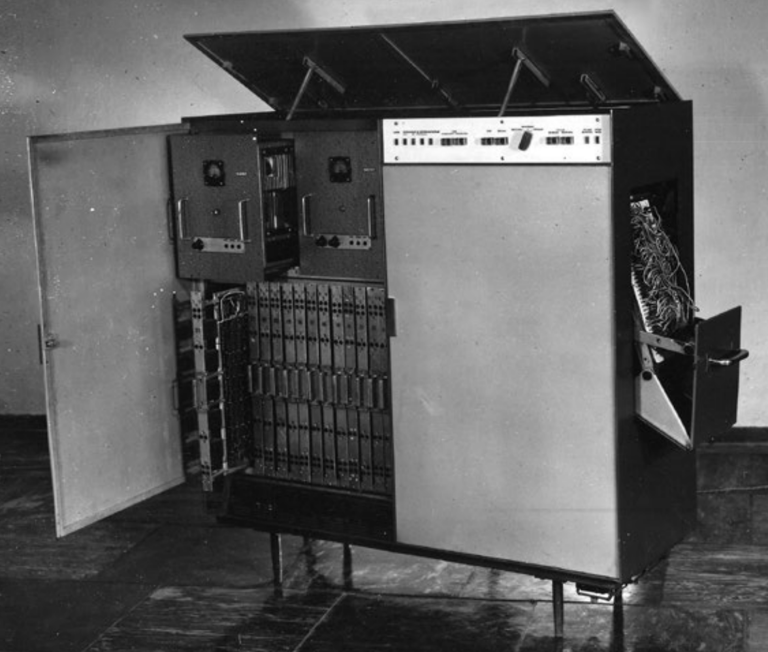
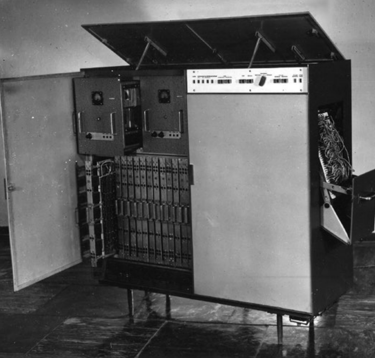
One of the two large parts of Rūta — electronic "calculator" — the machine's brain
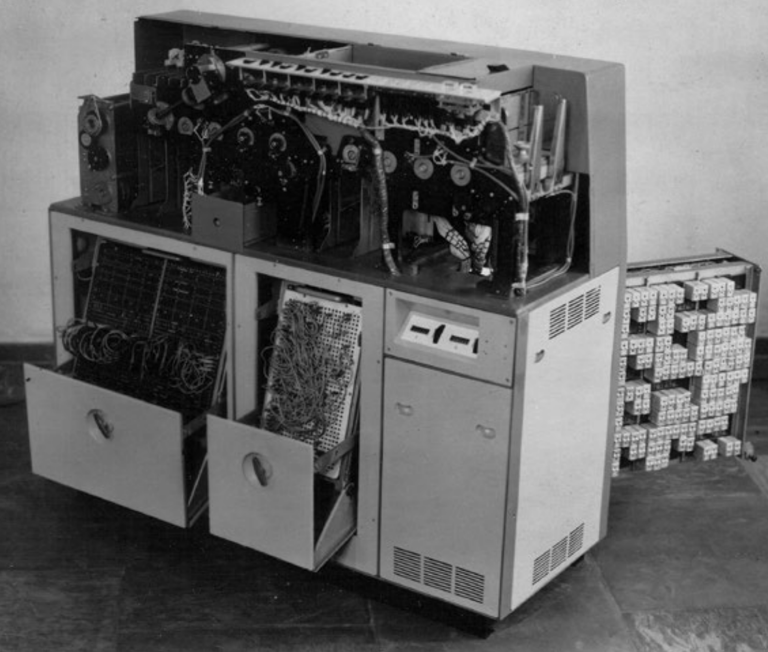
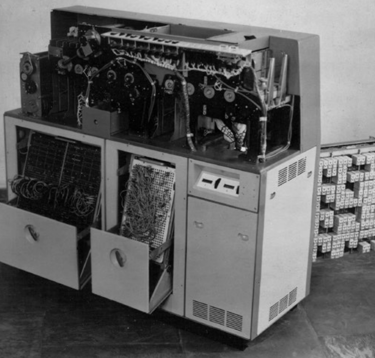
The second of the two large parts of Rūta — the electromechanical perforator


Rue (Lith. Rūta) - the modest flowering herb that is Lithuania's national plant
Contact us
tamos.projects@gmail.com
© 2021-2026 Computers.lt